Tuesday, December 1, 2015

December 1, 2015


Today we worked on getting ready for Build Season!! Some students cleaned up our workshop, while others worked on strengthening their skills in their sub-teams. The Animation team started working on their storyboard for the Safety Animation. The Programming team worked on learning the basics of Labview basics.
We can't wait for Build Season to start and all of the fun projects that will come along with that!

November 24th 2015

       This week our lead mentor has continued teaching a group of students how to operate our CNC mill. They worked on a piece for holding tools. We are getting a good start on the build season ahead.

       A CNC (Computer Numeric Control) mill is a mill controlled by a computer. Our CNC is precise to 1/10,000 of an inch, which allows us to make parts much more exact than anything done by hand. The CNC runs on G-code. One way to machine a part is to create the G-code "conversationally" (manually telling it what to do). The other option is to create a part in CAD (Computer Aided Design). Then we give that part to a specific program that will automatically create the G-code for running the CNC.

CNC lesson
     
       Some of our former students came back for a team meeting. It was a blast seeing some of our former students again!!


Tuesday, November 24, 2015

Nov. 17th 2015

       Today in the computer room, one of our mentors, Jordan, and the animation team began filming the parody video with a student acting for test shots. Also, they continued brainstorming for the safety animation video.


        In the machine room, a student and mentor finished a five drawer cabinet and repaired two   
       chairs.


Tuesday, November 17, 2015

November 5, 2015


  On November 5, 2015  USFIRST PhyXTGears Team 1720 took a plant tour of Littler Diecast Corporation in Albany, IN. There were 26 students and mentors present for the tour. President, Mr. John Littler, and two other employees divided the group into three parts to see the die casting process, machining area, and shipping area.
  Die casting is a sophisticated foundry process by which 1220 degree aluminum metal is forced into a steel die at high pressure to form a near net shape part. When the casting is removed from the die, it is cooled with water and then placed in a trim die. This removes the runner and overflows from the parting line of the casting.
  The casting can go in several directions based on the customer needs: 1. It can be machined. 2. It can be vibratory finished. 3. The casting can be impregnated to make it tight. 4. It can be powder coated, etc. or any combination of these secondary operations.
  Littler Diecast is a major sponsor of Team 1720. We appreciate his support and interest in out team and the chance to see his manufacturing operation.

Tuesday, November 3, 2015

October 31, 2015 and November 3, 2015


This past Saturday on October 31, 2015 we hosted an EV3 LEGO Workshop for 4th-8th grade students! The 4th-8th grade students were able to come to our workshop building to learn how to program and construct their own Lego robot. Our team was there to mentor the students on how to build, program, and how to fix their mistakes that they might have come upon. Once they were done with building their Lego robots, they were to program their Lego robots to do predefined tasks that we have given them to do, some of the tasks were to have the robot drive 12 inches, use the light sensor to find the red line then find the black line and turn, another task was to have the robot use the touch sensor then back up and turn.


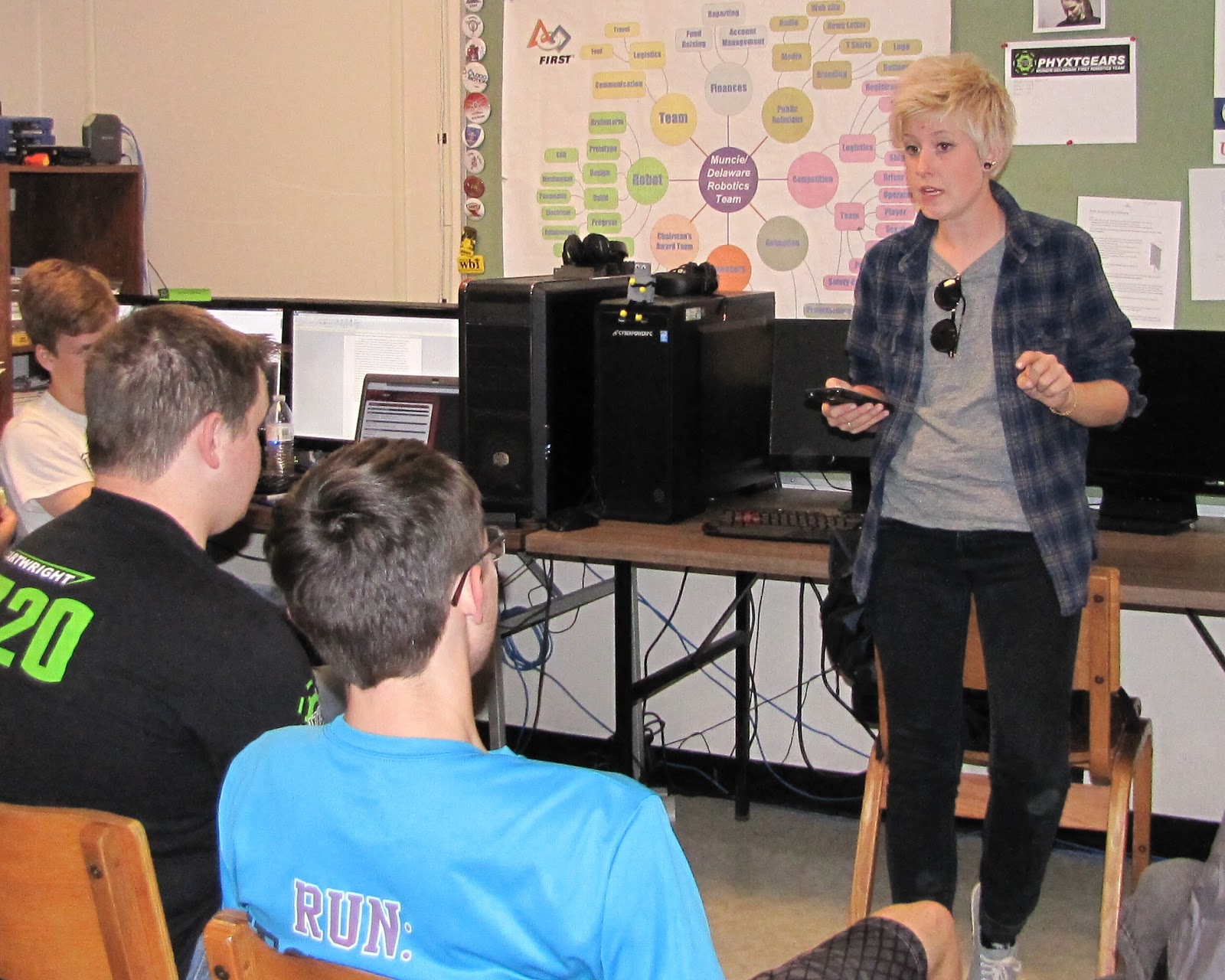
Today on November 3, 2015 we were able to have Dr. Meenu Goel visit us and give a wonderful presentation about how robots are used in medical facilities. She talked about some of the history behind robotic's use in medicine, starting with laparoscopy, or MIS, which stands for Minimally Invasive Surgery, all the way up to the Da Vinci System, an advanced set of robots designed to assist doctors in specific surgeries. This system provides doctors with 3-D magnified images of the patient. Thanks Dr. Meenu Goel!